The Ultimate Guide to Custom Banners: Good Guys Signs Framework
Choosing a banner material isn't primarily a question of which material is "best." The correct material depends on where the banner will be installed, how it will be supported, how much wind it will encounter, whether it needs to be viewed from one or both sides, the expected viewing distance, and how long it needs to remain installed.
After producing banners for applications ranging from storefront promotions and sporting events to construction fencing and large commercial installations, we've found that most banner failures can be traced to one of three things: the wrong material, the wrong finishing method, or the wrong installation method.
A 13 oz. vinyl banner that performs perfectly against a building can become a large sail when stretched between two posts. Mesh solves much of that wind-load problem but sacrifices some image density. A heavily perforated aero mesh reduces wind resistance further but makes little sense for graphics intended to be viewed from only a few feet away.
The objective, therefore, isn't to buy the heaviest or most expensive banner. It's to match the material and construction method to the environment in which the banner actually has to perform.
Five Questions to Ask Before Choosing a Banner
1. Where will the banner be installed?
Indoors, against a building, on a fence, between posts, on scaffolding, or on pole brackets all impose different requirements.
2. How much wind will reach the face of the banner?
A banner mounted against a solid wall behaves very differently from the identical banner stretched across an open fence.
3. How far away will people view it?
Increasing mesh openness improves airflow but reduces printable surface area and fine-detail reproduction.
4. Does the message need to be visible from one direction or two?
Two-sided applications require an opaque blockout layer so the opposing image doesn't show through.
5. How long does it need to remain installed?
A weekend promotion and a long-term construction perimeter shouldn't automatically receive the same material, finishing, or installation method.
Banner Material Deep Dive
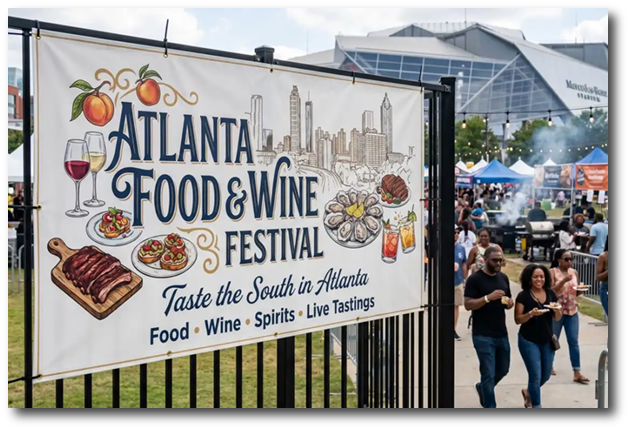
13oz. Vinyl Banners: The General Purpose banner of choice.
- 13 oz. scrim vinyl is the workhorse of commercial banner printing. A polyester scrim is embedded within PVC, giving the material strength while retaining a smooth printable surface.
- For most conventional banner applications, 13 oz. vinyl provides an excellent balance of print quality, durability, and cost.
- The important qualification is how the banner is installed.
- A solid vinyl banner mounted against a building or other solid surface experiences relatively little wind pressure. Put the same banner between two poles or across an open span, however, and its solid surface begins behaving like a sail.
- In sufficiently strong winds, the banner may stretch, sag, tear around its attachment points, or transfer substantial loads into the structure supporting it. We've seen improperly installed solid banners exert enough force to damage their supports.
- Choose 13 oz. vinyl when: image quality and economy matter and wind exposure is controlled.
- Consider mesh instead when: significant wind can reach both the front and back of the banner.
Standard Mesh Banners
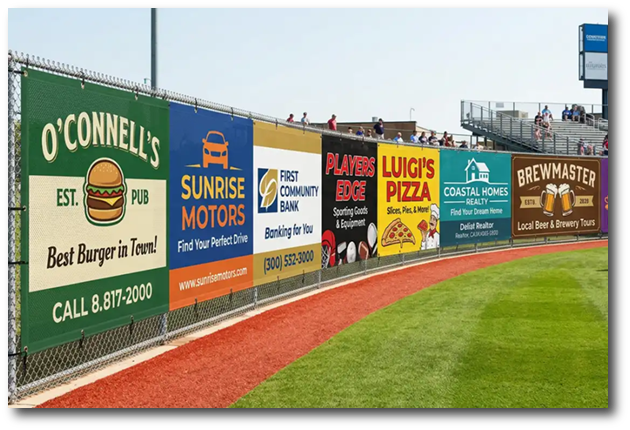
Banner selection involves a tradeoff between printable surface area and airflow. Solid 13 oz vinyl has maximum printable surface area but can act like a sail. Mesh banners have slightly less printable surface area but allow more airflow.
If you need to hang outdoor banners in an open area, such as between two posts or across a sports field barrier, wind becomes your biggest enemy. (If you are new to these specific applications, check out our full breakdown on what fence banners are). Standard mesh material is specifically engineered to solve this problem while maintaining strong visual clarity.
Unlike solid substrates, these custom mesh banners feature a crisscross weave, typically utilizing a 70/30 ratio of vinyl to holes. This allows a significant amount of air to pass right through the fabric. This breathability drastically reduces the wind load, preventing the banner from billowing, ripping at the grommets, or knocking over temporary fencing. When produced with high-quality OEM inks, the graphics remain sharp and fade-resistant despite the perforations.
- Sports Facilities: Perfect for wind-resistant banners on little league baseball outfield fences or tennis court sponsorships.
- Event Barricades: The industry standard for crowd-control barriers at outdoor concerts, marathons, and local street festivals.
- Design Tip: Because of the perforations, highly intricate details or very small text can get lost. Stick to bold graphics and high-contrast colors.
Aero Mesh Fence Banners
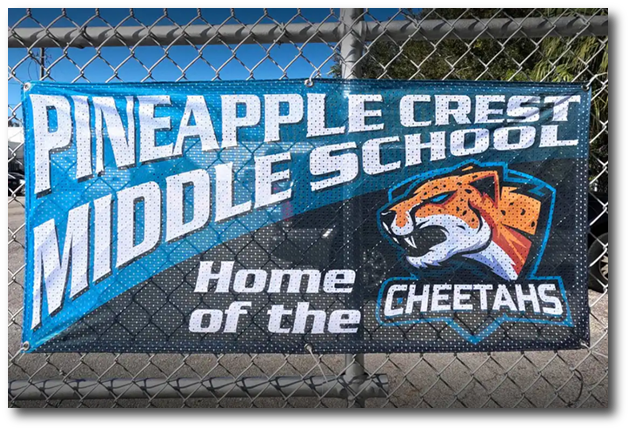
Aero mesh takes the concept of the standard mesh banner and pushes it to the extreme. Engineered for structural safety, these heavy-duty fence wraps feature a much more open weave, often closer to a 50/50 ratio. This allows for maximum airflow and provides substantially more airflow than standard mesh, making it appropriate when minimizing wind resistance is a primary consideration.
When reducing wind load is the overriding design consideration, this more open mesh is appropriate. Its more open construction allows substantially more air to pass through the banner than conventional mesh. That reduces the load transferred from the banner to its attachment points and supporting structure. The supporting structure and installation still need to be appropriate for the expected loads.
- Large-Scale Construction: An excellent material for construction site banners, including scaffolding wraps for high-rise developments and miles-long perimeter fencing.
- Coastal Corridors: Frequently used for marinas or coastal event spaces that regularly experience heavy, unpredictable winds.
- When to Avoid: Up-close viewing. The large holes in this high-wind banner material mean the image resolution will look pixelated from just a few feet away; it is designed strictly for distance viewing.
18oz. Double-Sided Banners
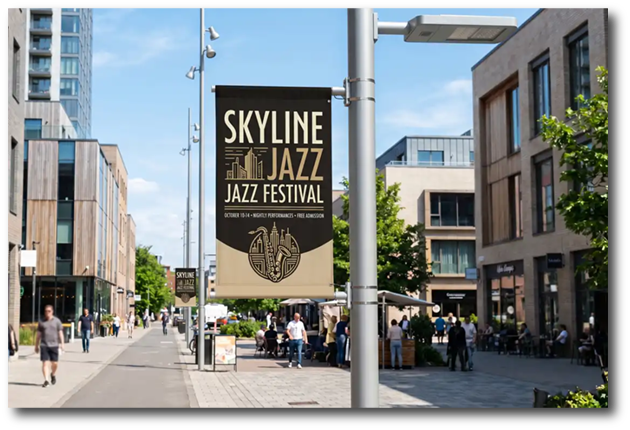
When you need your message seen by traffic coming from both directions, a double-sided approach is required. Standard 13oz vinyl is not suitable for this because it allows sunlight to pass through, causing the image on the back to cast a distracting shadow on the front.
To solve this, double-sided vinyl banners are printed on premium, heavy-duty blockout vinyl (usually 18 oz.). This thick material contains a light-blocking black layer embedded directly in the center, ensuring that neither side interferes with the other, even in harsh, direct sunlight. Double-sided banners aren't merely two prints placed back-to-back. The substrate must prevent light and imagery from one side from interfering with the other.
- Street Signage: The go-to choice for heavy-duty pole banners in downtown districts, municipal events, and over-the-street hanging displays.
- Commercial Lots: Ideal for vertical light pole brackets in auto dealership lots and shopping center parking areas.
- Trade Shows: Excellent for suspended ceiling signs in convention centers where attendees approach the display from 360 degrees.
Custom Canvas Banners
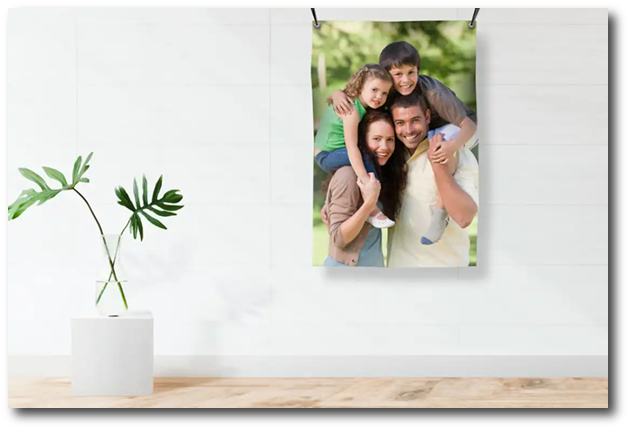
When interior aesthetics and sophisticated textures are more important than weatherproofing, indoor custom canvas banners are the superior option. Canvas is a high-quality woven fabric (often a poly-cotton blend) that provides a rich, artistic feel that standard PVC simply cannot replicate.
Canvas has a low-glare, textured appearance that can provide a softer, more upscale presentation than conventional PVC banner material. Paired with advanced digital printing equipment, canvas delivers a gallery-quality finish.
- High-End Retail & Corporate: The ultimate choice for premium fabric banners, luxury window displays, corporate office lobbies, and boardroom decor.
- Events & Entertainment: The standard for glare-free red carpet step-and-repeat backdrops, church stage designs, and museum exhibitions.
- When to Avoid: Extended outdoor use. While canvas offers an unmatched high-end look indoors, it will not hold up to harsh rain, dirt, or prolonged UV exposure like a custom outdoor banner will.
Quick Comparison Guide
| Banner Type | Ideal Environment | Key Advantage | Best Use Case |
| 13oz Vinyl | Indoor / Outdoor | Most cost-effective, vibrant colors | Flush-mounted outdoor promotions |
| Standard Mesh | Outdoor | Allows airflow and reduces wind load | Standard chain-link fence advertising |
| Aero Mesh | Outdoor High-Wind | Greater airflow than standard mesh | Large construction perimeter wraps |
| Double-Sided (18oz.) | Indoor / Outdoor | Visible from 2 directions, blocks light | Street pole or overhead banners |
| Custom Canvas | Indoor | Glare-free, premium aesthetic | High-end retail |
Common Banner Selection Mistakes
- Using solid vinyl in an exposed open span.
The material may be perfectly suitable, but the installation exposes the entire face to wind. - Choosing mesh when close-up image quality is the priority.
More airflow generally means less printable surface. That's a worthwhile tradeoff when wind matters but unnecessary when it doesn't. - Assuming "heavier" automatically means "stronger" or "safer."
Material weight is only one variable. Construction, reinforcement, mounting method, and supporting structure matter too. - Treating finishing as an accessory.
Grommets, hems, stitching, and pole pockets aren't decorative options. They're the points through which loads are transferred from the banner into the mounting system.
The Finishing Touches: Hems, Grommets, and Pole Pockets
Selecting the right material is only the first step. How your custom banner is finished dictates how well it can be installed and how long it will survive in the wild.
- 1-Inch Hem Tape: A raw cut edge of vinyl is susceptible to tearing. For standard 13oz vinyl banners, the edge is folded over and secured with heavy-duty 1-inch hem tape, making the perimeter double-thick. This reinforcement drastically increases the structural integrity and provides a strong, reliable anchor point for hanging hardware.
- Double-Needle Stitching: Because aero mesh banners are deployed in the most extreme, high-wind environments, their edges require even greater reinforcement. We finish these heavy-duty fence wraps with commercial double-needled stitching, ensuring maximum structural hold across massive installations and long-term use.
- Grommets: These are metal eyelets punched through the taped or stitched hems, typically spaced every 24 inches. They provide reinforced holes for hanging. By placing grommets exclusively through finished edges rather than raw cuts, the risk of them tearing out during high tension is significantly reduced.
- Pole Pockets: Instead of grommets, the top (and sometimes bottom) of the banner is looped and secured to create a sleeve. This is the industry standard for street pole banners, indoor trade show backdrops, and parade banners where a rigid pole will be slipped through the material to keep it perfectly taut.
- Wind Slits have traditionally been used in solid vinyl banners in an attempt to reduce wind pressure. However, cutting openings into solid vinyl also introduces additional edges and potential stress points. When meaningful wind exposure is expected, selecting an appropriate mesh material is generally preferable to attempting to convert solid vinyl into a wind-permeable material. If the location is known to be very windy, we highly recommend upgrading to a mesh banner or aero mesh. Mesh materials are structurally engineered to handle heavy wind loads safely and effectively without the need to cut into a solid substrate.
Why Banner Installation Matters: Follow the Load
Wind doesn't simply act on the banner material. The force has to go somewhere.
Wind → banner face → reinforced edge → grommet or pole pocket → attachment hardware → supporting structure
This is why simply buying a heavier banner doesn't necessarily solve a wind problem. A well-manufactured banner transfers the load into its mounting system. If the mounting hardware, fence, pole, or other supporting structure isn't capable of handling that load, making the banner itself stronger doesn't eliminate the problem—it can simply transfer more force to the next component.
A banner should therefore be thought of as a system, not simply as a printed sheet of material.
The Golden Rules of Banner Design
Even with state-of-the-art production hardware, the final printed banner is only as good as the digital file provided. Preparing your artwork correctly and designing for preattentive vision so your sign stands out instantly reduces turnaround time and ensures your final product looks professional, legible, and vibrant. Following a few fundamental prepress rules will guarantee your design is ready for commercial-grade printing:
- The 10-to-1 Letter-Height Guideline: Banners are fundamentally designed to be read from a distance. A useful starting point for banner readability is approximately 1 inch of letter height for every 10 feet of viewing distance. It should be treated as a guideline rather than a guarantee. Typeface, stroke width, contrast, viewing angle, illumination, surrounding visual clutter, and the speed of a passing viewer can all affect actual readability. For example, a message viewed by someone walking through a trade show has much more viewing time than the same message seen from a vehicle traveling 45 mph.
- Color and Color Profiles: A computer monitor produces color with light, while a printed banner produces color with ink on a physical substrate. For that reason, the appearance of an uncalibrated monitor should never be treated as a guarantee of printed color. For color-critical logos or corporate colors, provide known color values or spot-color references when available and discuss proofing requirements before production. Proper color management is more important than simply converting every file from RGB to CMYK.
- Safe Zones and Bleeds: Keep all critical information (like text, logos, and phone numbers) at least 2 inches away from the edges of your file. This creates a "safe zone" that ensures nothing important gets cut off or covered up during the hem tape and grommet installation process.
- High-Resolution Assets (Vector vs. Raster): The type of files you use can make or break a large-scale banner. - Vector Graphics: Whenever possible, use vector files (.EPS, .AI, or .SVG) for your logos, shapes, and text. Vector graphics use mathematical equations to map out the image, meaning they can be scaled to the size of a massive construction wrap without ever losing quality or becoming blurry. - Raster Image Resolution: Required image resolution depends partly on viewing distance. A banner intended to be examined from several feet away requires greater effective resolution than a massive construction graphic normally viewed from across a street or parking lot. As a practical rule, avoid enlarging small web images for large-format printing. When image quality is uncertain, have the file evaluated at its final output dimensions before production.
How Banner Manufacturing Affects Performance

The basics of banner printing are Printing → cutting → edge reinforcement → attachment points By using premium materials and equipment, premium banners look good and last longer.
The longevity and visual impact of a banner rely heavily on the commercial equipment used to manufacture it. Producing high-quality signage at scale requires quality printing technology and automated cutting to ensure accuracy across every substrate. At Good Guys Signs: These operations are performed using production equipment, including:
- Canon Colorado M5 & Durst P5 350 HS: These industrial printers are utilized for our 13oz vinyl, 18oz. double-sided, standard mesh banners, and custom canvas banners. The Canon Colorado's UVgel technology and the Durst’s high-speed UV-curing process ensure that inks instantly dry and bond to the substrate.
- Dye Sublimation for Aero Mesh: Our Aero Mesh is produced on a polyester mesh using dye-sublimation printing. During sublimation, the dyes become part of the polyester fibers rather than forming a conventional surface ink layer. This produces a flexible printed graphic well suited to fabric-based mesh applications.
- Zund G3 XL Precision Cutting: Hand-cutting large-scale banners introduces the risk of uneven edges, which can lead to structural weak points and fraying over time. To eliminate this, printed banner rolls are processed through a Zund G3 XL digital cutter. This automated system delivers exact, computer-guided cuts down to the millimeter. This provides repeatable, computer-controlled cutting for hems and pole pockets and consistent sizing across multi-panel projects.
The Bottom Line
The right banner isn't necessarily the heaviest, most expensive, or most durable material available. It is the material best matched to the installation.
Start with the environment: Where will the banner be installed? How much wind will reach it? How far away will it be viewed? Does it need to be printed on one side or two? How long does it need to remain in service?
Those answers help determine the appropriate substrate. The substrate and installation environment then determine the appropriate finishing and attachment methods.
For outdoor installations, remember that the banner does not operate independently. Wind loads the banner; the banner transfers that load through its reinforced edges and attachment points into the mounting hardware and ultimately into the supporting structure.
A banner is a system—not simply a printed sheet of material.
Choosing each part of that system for the actual installation environment is the foundation of a banner that performs as intended.
Whether the application calls for an aero mesh wrap on an exposed perimeter fence, a double-sided blockout banner viewed from two directions, or indoor canvas where texture and low glare matter, the principle remains the same: match the material, finishing, and installation method to the environment.
 (800) 215-6424


