
Introduction
In today’s fractured political landscape, winning comes down to margins. And the best way to improve your margins is by understanding that the concerns of a voter on Main Street might be vastly different from the concerns of a voter just two blocks over on Elm Drive.
This is the era of neighborhood microtargeting: moving beyond demographics to psychographics and geolocation to win hearts and minds, block by block.
What is Neighborhood Microtargeting?

At its core, political microtargeting is the use of analytics to identify specific interests of small groups or individuals to influence their voting behavior.
When applied to neighborhoods, it means recognizing that geography is often important when it comes to political concerns. A neighborhood near a noisy highway has different priorities than a quiet cul-de-sac near a proposed new elementary school.
Microtargeting isn’t magic; it’s math. It relies on layering different types of data to create a comprehensive profile of a specific geographical area.
- Voter Files: Every campaign starts here. Public voter registration data tells you who lives where, their party affiliation, and their vote history. Though raw, somewhat messy files are available from the state, most organizations buy cleaned up, appended files from aggregators.
- Consumer Data: Campaigns layer in commercial data purchased from vendors. Magazine subscriptions, car ownership records, and charitable donations help build a “lifestyle persona” for a neighborhood.
- Geofencing: This is where digital meets physical. Campaigns can draw a virtual perimeter around a specific neighborhood, down to a few city blocks, and serve digital ads only to devices detected within that boundary.
Strategies for the Hyper-Local Campaign
Data is useless without action. Once you have identified the unique characteristics of different neighborhoods, you must tailor your campaign strategy accordingly.

- Tailored Messaging:
The biggest mistake campaigns make is sending a generic “I stand for lower taxes and better schools” mailer to an entire district
In a micro-targeted campaign, the message matches the voter location.
- Neighborhood A is worried about a proposed rezoning for a commercial development. The candidate’s literature dropped on these doorsteps should focus entirely on zoning and protecting property values.
- Neighborhood B has a high density of young families. The messaging here should focus heavily on parks, libraries, and school board issues.
When a voter receives a piece of mail that speaks directly to an issue they discussed at the dinner table last night, they feel “seen” by the candidate.
- Matching the Medium to the Message:
How you deliver the message is just as important as the message itself.
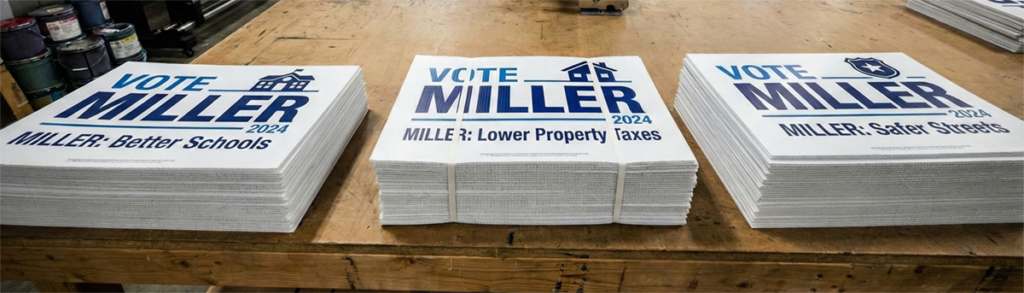
- Local Yard Signs: Most campaigns treat yard signs as simple name recognition tools (Name + Office). But in a microtargeted campaign, yard signs become policy statements. Instead of just your name, print a tagline relevant to the specific block. A “Smith for Council: Safer Streets” sign placed in a neighborhood concerned about traffic holds much more weight than a generic sign. It tells the neighbors that the homeowner trusts the candidate on the issue that matters the most to them.
- Canvassing: Door-knocking remains the most effective persuasion tool. Modern apps guide volunteers only to “persuadable” voters in specific neighborhoods with a script tailored to that area’s issues.
- Digital Ads: Use IP targeting to serve banner ads or short videos on local news sites that are only visible to specific zip codes or neighborhoods.
Conclusion: The Personal Touch Wins
While data and technology drive the strategy, the ultimate goal of neighborhood microtargeting is human connection. It’s about showing voters that a candidate isn’t just looking at a spreadsheet of demographics but understands the specific, daily realities of life on their street.
One common barrier to this strategy is the fear of cost. Campaign managers often assume that printing different yard sign designs for different neighborhoods means losing out on bulk pricing.
At Good Guys Signs, we structure our pricing to support this exact strategy because we understand what works best in hyper-local races.
Did you know if you buy 5 different designs with 20 signs each, targeting 5 separate neighborhoods, we give you the much cheaper price per sign for the total volume of 100?
Instead of paying the higher “small batch” price five times, you get the bulk rate. The only difference is a modest $16 charge for the design splits. In that scenario alone, you save over $200 compared to standard printing pricing models.
You get the precision of microtargeting with the power of bulk pricing. We are ready to help you win your race, block by block. Reach out to us today to get started!